


With the Polish Presidency of the Council of the EU now well underway, it is worth reflecting on what we can expect from the next six months. Warsaw will be facing some formidable challenges during its time at the helm. The threat posed by Russian revisionism and irredentism[1] will continue to dominate the EU’s political agenda. Few Member States will agree more vigorously than Poland that this remains the EU’s overarching and immediate strategic challenge. Poland’s Presidency will overlap with a critical juncture in the war. With President Trump’s return to the White House, the US is slated to return to a highly transactional approach to international relations and a focus on the Asia-Pacific region. This will pose fundamental challenges to the Allied response to Russia and the broader transatlantic relations. The war in Ukraine risks being portrayed as drawing the attention of the United States away from its interests in the Asia-Pacific region. Moreover, the strongly institutionalised nature of Europe’s security order – through NATO, the EU and the OSCE – is likely to be seen as a symbol of the international rules-based order that might irk the Trump administration.
While US criticism of chronic European underspending on defence is legitimate, it is difficult to accuse Poland of freeriding on US security guarantees – with national defence investments projected at a whopping 4.7% for 2025, up from 4.1% in 2024.[2] Moreover, Poland’s procurement spree was directed almost exclusively to US and South Korean firms. Poland also plays a key role in enabling the US force posture in Europe. It already hosts the US Army V Corps Forward Command.[3] The logistical base in Poland’s southeastern town of Rzeszów is a crucial hub for sending aid to Ukraine. In July 2024, the construction of an Aegis ashore battery in the North of Poland was completed, strengthening US ballistic missile defence capabilities in the Baltic Sea region.[4] Another element cementing Poland’s position as a bridge with the Trump administration is its gas import infrastructure. Warsaw constructed a liquified natural gas (LNG) terminal in Świnoujście that can help unlock the Central European gas market to lucrative American LNG exports. For all these reasons, Poland is ideally placed to maintain American engagement in European security and defence.
In terms of the policy areas that must be prioritised during the first half of 2025, mitigating the Russian threat will remain primarily a military and defence industrial matter. On the EU level, there are several instruments and budgets that can be leveraged to confront the military aspect of Russia’s irredentism. But these initiatives require the Presidency’s political and diplomatic attention. For example, the Hungarian Presidency failed to reach an agreement between EU institutions and Member States on the European Defence Industry Programme (EDIP). This is currently being negotiated with the aim of spending €1.5 billion in the period 2025-2027 to foster the bloc’s arms manufacturers and ensure the availability and supply of defence products. The Polish Presidency will have to continue these negotiations and deliver results.[5] While the EDIP spans only a very limited budget, it touches on fundamental choices about the EU’s future security identity and strategic priorities. Some of these choices relate to the geographic orientation of CSDP and CFSP. How does the existential threat that Russia poses to Central and Eastern European countries weigh against the security crises in Africa and the Middle East whose risks mainly concern Southern and Western EU Member States? Do we focus on shaping national inventories, infrastructure and arms industries into accommodating NATO’s deterrence and defence? Or do we pour our finite defence budgets into capabilities that enable EU crisis management operations overseas? Other choices relate to which kind of security actor the EU is or intends to be. Do we focus on immediately procuring capabilities wherever they are available in the world, or do we leverage the scale of the current military needs as an opportunity to build up a robust European defence industrial base in the long term? Is the EU a great power in its own right or does it remain a peace project that acts as an appendix to the American empire? To provide guidance to such questions, the European Commission is currently drafting a White Paper on the future of European defence. The Polish Presidency, for its part, must ensure that investments in the European defence industry align with the priority procurement needs of the Member States.
There are also less conspicuous EU instruments that can enhance European security. For example, the Connecting Europe Facility (CEF) is a financial instrument that can be used to enhance logistical infrastructure located on the Trans-European Transport Network (TEN-T). While the limited sum specifically reserved to cofinance projects that improve military mobility has already been exhausted (1.7 billion euros), other infrastructure works on the TEN-T can still contribute to this goal. The European Commission must keep a strategic focus when allocating funds in the remaining calls for proposals in the multiannual financial framework (MFF) 2021-2027. Moreover, the next MFF 2028-2035 is currently being negotiated, and again raises questions about the EU’s identity and strategic orientation. East or South? Expeditionary crisis management or continental deterrence and defence? These questions must also be answered on the level of Member States. They must take strategic responsibility by coordinating their national investments in logistical infrastructure even when not financially incentivised by the CEF. They also need to further simplify and harmonise their regulations for military transports. NATO’s Netherlands-Germany-Poland military mobility corridor sets a precedent in this regard. As one of the participating countries, Poland can use the activities it organises under its EU Presidency to accommodate the exchange of lessons learned in the NDP-corridor with the steering groups of other corridors currently being developed.
Mitigating the military aspects of Russian revisionism also requires coordination between the EU and NATO, as well as between their respective members. As the largest NATO ally and EU Member State in Central and Eastern Europe, Poland could harmonise the procurement of strategic assets between both organisations based on the most pressing needs. An interesting possibility would be to draw further on the existing Berlin Plus arrangement. This agreement stems from the 1990s and gives the EU access to NATO capabilities for crisis management missions. This logic could work in the other direction as well. Given NATO’s return to deterrence and defence, the alliance would benefit from having access to enabling capabilities that are of a dual-use nature (such as locomotives, flatbed wagons or roll-on/roll-off ships). These could be procured and managed as part of a strategic reserve on the EU level and be made available to NATO’s collective defence efforts if required. The EU could also create a tier-based strategic pool of crisis support personnel (e.g. drivers, sailors, construction and railroad workers, civil and industrial engineers, factory workers) that could assist in managing the consequences of a NATO mobilisation.
The Polish Presidency will also have to foster agreements between Member States about security challenges of a non-military nature. Russia’s sabotage of critical underseas infrastructure risks undermining the economic and political security of EU and partner countries. The supply of electricity to the Baltic states has become a precarious issue, as they are decoupling themselves from Russian supplies. Data-cables have been sabotaged in the Baltic Sea, which risks compromising the economies of its littoral states. Finally, the Central and Eastern European region had been highly dependent on Russian gas by way of a major gas transit agreement that had remained in place between Russia and Ukraine even after Russia’s full-scale invasion. However, as Kyiv did not renew it, this agreement expired on the 1st of January 2025. This poses a fundamental strategic problem for landlocked countries such as Hungary and Slovakia and compels their Eurosceptic governments to turn to other EU Member States for their natural gas needs. For example, Slovakia leveraged the infrastructure of its neighbouring countries to reduce its dependence on Russian gas from 85% in 2021 to 50% in 2023.[6] Poland can leverage its geographic location and energy transportation infrastructure to shore up its role as a key mediator between landlocked EU Member States that are forced to wean themselves off Russian gas and further integrate their gas market with the rest of the EU. Poland will also be crucial in providing energy to Ukraine and Moldova to ensure their further integration into the Euro-Atlantic security community. A possible institutional format for this is the Three Seas Initiative (3SI). Poland’s previous government has been one of the main driving forces behind the 3SI. As the current government is more aligned with Germany, it may seek to reinvigorate the 3SI with a more EU-oriented approach.
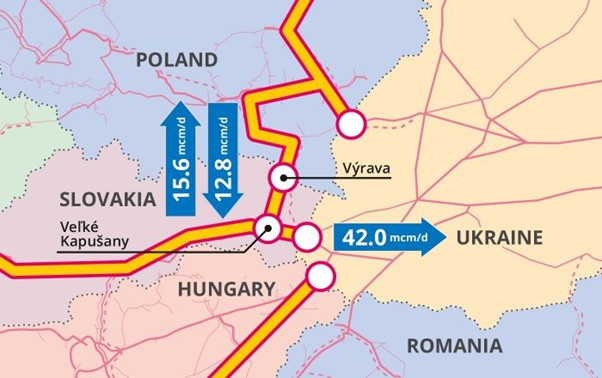
Polish natural gas transportation links with Ukraine and Slovakia (in 2022)[7] (Source: GTSOU)
The current context within the EU is conducive for Polish leadership to drive and leave its mark on existing and new EU initiatives. Germany and France, the EU’s traditional protagonists, face severe domestic headwinds and might not be able to lead Europe’s response. Against the backdrop of the start of the second Trump administration, Poland will set the tone of the transatlantic relation for the next four years. Warsaw has manoeuvred itself into the best possible place to lead Europe’s response. Warsaw’s US-centric defence procurement spree allows it to act as a bridge between the future Trump administration and the EU. It is also geographically and infrastructurally well placed to mitigate both military and other security challenges that confront the countries on the Eastern flank. Finally, as its national strategic challenges correspond to those of the EU as a security community, it has every incentive to leverage its EU Presidency to make as much progress as possible to forge the EU’s future security identity and strategic orientation.
[1] Revisionist powers pursue fundamental changes to the international system in its current form, as opposed to status quo powers. ‘Irredentism’ refers to a state’s desire of seizing territories or communities which currently fall outside of its borders but are believed to form part of its historical dominion.
[2] Aleksandra Krzysztoszek, “Poland to increase defence spending plans in 2025 – media reports,” Euractiv, August 27, 2024, https://www.euractiv.com/section/politics/news/poland-to-increase-defence-spending-plans-in-2025-media-reports/.
[3] Ministry of National Defence, “Increasing the US military presence in Poland,” accessed January 8, 2025, https://www.gov.pl/web/national-defence/increasing-the-us-military-presence-in-poland#:~:text= Currently%2C%20a%20total%20of%20about,part%20of%20a%20rotational%20presence.&text= V%20Corps%20Forward%20Headquarters%20is,the%20US%20Army%20permanent%20presence/.
[4] NATO, “NATO missile defence base in Poland now mission ready,” July 10, 2024, https://www.nato.int/cps/en/ natohq/news_227649.htm/.
[5] Laura Kayali, “French defense minister calls for scrapping EU arms cash fund if it can’t be fixed,” Politico, January 7, 2025, https://www.politico.eu/article/frances-lecornu-better-no-edip-than-get-it-wrong-trump-ukraine-weapons-procurement/.
[6] Krzysztof Dębiec, “Slovakia’s actions in preparation for the expiry of the Ukrainian-Russian transit agreement,” Centre for Eastern Studies (OSW), December 20, 2024, https://www.osw.waw.pl/en/publikacje/analyses/2024-12-20/slovakias-actions-preparation-expiry-ukrainian-russian-transit/.
[7] Transmission System Operator Ukraine, “Ukrainian traders have received expanded access to LNG terminals in Poland and the Baltic states,” August 26, 2022, https://tsoua.com/en/news/ukrainian-traders-have-received-expanded-access-to-lng-terminals-in-poland-and-the-baltic-states/.

